

VOICE
An Interview with Yu Yue, President of Harbin Cambridge University
PROFILE
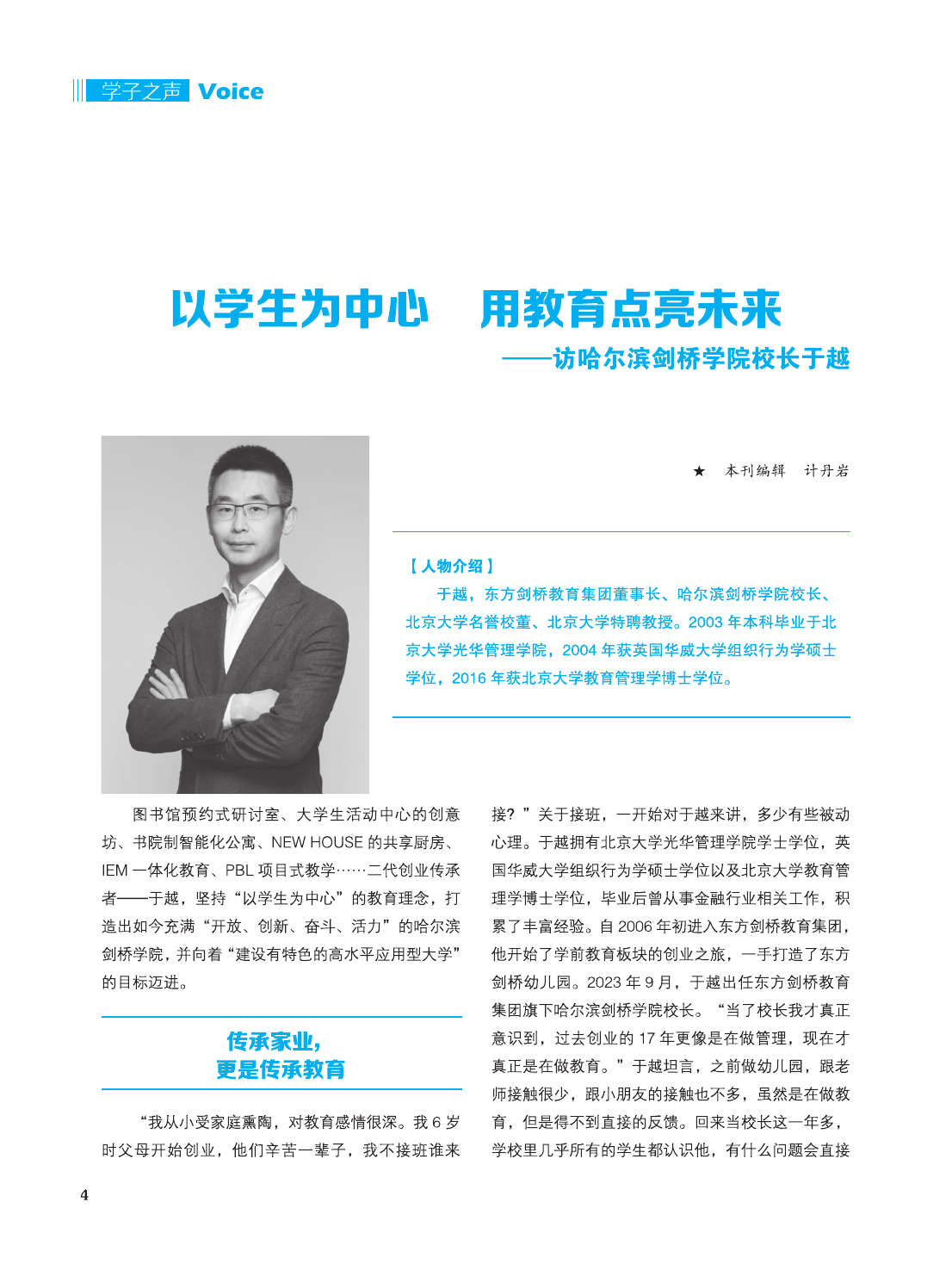
Yu Yue is chairman of Oriental Cambridge Education Group and president of Harbin Cambridge University. He is also an honorary trustee and honorary professor at Peking University. He graduated from Peking University’s Guanghua School of Management in 2003, earned a master’s degree in organizational behavior from the University of Warwick in the UK in 2004, and received a PhD in educational economy and management from Peking University in 2016.
Students can reserve library rooms with a few taps on their phones, work in creative studios at the student activity center, and use shared kitchens in NEW HOUSE, a newly renovated dining hall. Student residences are also equipped with smart technology. The residential college system, the Integrative Education Model (IEM) and project-based learning (PBL) further reflect Yu Yue’s commitment to student-centered education. A second-generation entrepreneur building on his family’s legacy, Yu has fostered a culture of open-minded, creative, striving and vibrant at Harbin Cambridge University. The university is working toward its goal of becoming a distinctive, high-caliber institution dedicated to applied learning.
“I grew up immersed in my family’s commitment to education, and it has always meant a great deal to me. My parents started their business when I was six. They have worked hard all their lives, so who else would carry it on, if not me?” For Yu, however, taking over the family business initially felt more like an obligation than a choice.
Yu holds a bachelor’s degree from Peking University’s Guanghua School of Management, a master’s degree in organizational behavior from the University of Warwick and a PhD in educational administration from Peking University. Before joining Oriental Cambridge Education Group (OCEG), he also gained substantial experience in finance. When he joined the group in early 2006, he began developing its preschool education business and went on to establish the Oriental Cambridge kindergarten network.
In September 2023, Yu was appointed president of Harbin Cambridge University (HCU), an institution within OCEG. “It was only after becoming president that I realized my previous 17 years working in the group had been more about management. Now I am truly working in education,” he said.
Yu acknowledged that during his earlier work in the preschool sector, he had little direct contact with teachers and children. Although he was working in education, he rarely received immediate feedback from the people it served.
That changed during his first year as president at HCU. Nearly every student on campus came to know him, and many began leaving comments under his Douyin posts when problems arose. When a student with a leg injury needed a seated toilet, Yu had the university replace a squat toilet within a single afternoon. He encouraged students to develop their own solutions to the campus’s stray-cat issue while providing support when needed. He also gave students responsibility for independently planning events such as the university sports meet and the welcome gala for new students, meeting with them face to face to discuss their proposals.
“Students point out where the university can improve. After graduation, they also tell me what they gained from their education, what they learned from me, how I inspired them and how much of an impact it had,” Yu said. For him, this creates a positive, two-way flow of feedback and gives him a stronger sense of purpose in education.
“Working in education—especially as a teacher—gives you the opportunity to change the course of someone’s life. I did not fully appreciate this until I returned as president at the university. Of my nearly 19 years in education, the past year and a half has given me the most direct experience of education’s value,” he said. His own transformation over the years has gradually turned succession from an obligation into a genuine commitment to carrying forward the family’s educational mission.
The handover also involved negotiation between father and son. They belonged to different generations, had different experiences and backgrounds, and faced different challenges. As a result, they sometimes disagreed over ideas and methods, and friction was unavoidable. This was the first challenge Yu faced.
“As I assumed greater responsibility for the group, the biggest difficulty was that my father and I had different management philosophies, which led to disagreements. Overall, however, he made significant concessions and gave me room to try new approaches. He left me to lead many of the group’s initiatives, including the launch of the new campus in Yantai,” Yu recalled.
“I have long had many ideas about what an ideal university should be. If we want to equip graduates with the skills and qualities employers need, we must understand how businesses and industries operate. I wanted to combine my industry experience with my educational ideals and bring the university closer to industry. That is why I chose to return and take on the presidency in addition to my other responsibilities,” he said.
After becoming president of Harbin Cambridge University, Yu identified several areas for improvement. As a university focused on applied learning, it needed close ties with industry. National policy had long emphasized industry–education integration, and the university had actively explored ways to pursue it, but implementation still had room to improve. The faculty included teachers with both academic and industry credentials, yet members of the management team generally had less hands-on business experience.
University representatives had also visited companies to explore internship and employment opportunities for students. These initial contacts, however, had yet to develop into deeper partnerships. After all, visiting a company to learn about its operations is very different from working there or starting a business yourself.
Changing mindsets presented another challenge. Many staff members had spent their entire careers in education, and long-established practices had become ingrained. Yu concluded that simply repeating new ideas would have limited effect. He needed to lead by doing, helping staff gradually understand new approaches and change both their thinking and their behavior.
The final challenge was encouraging students themselves to change. Yu considers student agency essential, yet believes many university students today lack it. No matter how much a university provides, its efforts will have limited impact unless students take initiative. He therefore believes the university should help students develop four core capabilities and three broader qualities.
The first capability is agency. Whether in study, work or daily life, people who lack initiative, remain passive or continue to depend on their parents will accomplish little. Yu therefore sees the development of student agency as the university’s foremost task.
The second is the capacity for lifelong learning. Technology is transforming every industry, and people who stop learning risk quickly falling behind. One of Yu’s first initiatives at Harbin Cambridge University was to redefine the university as a student-centered organization for lifelong learning, emphasizing that education should equip students to continue learning throughout their lives.
The third is critical thinking, which depends on logical reasoning. In an age of information overload, students must be able to judge whether information is accurate and useful. They also need logical thinking to set priorities and approach their future work in an organized way.
The fourth is innovative thinking. With artificial intelligence developing rapidly, people must continue to innovate if they are to stay ahead of machines. Innovation, Yu believes, is therefore essential.
Alongside these four capabilities, Yu believes universities should foster digital literacy, professionalism and a grounding in the humanities. In his view, what most distinguishes people from machines in the future may well be their humanity. The more advanced technology becomes, the more important the humanities become. These educational ideas, he said, have been distilled from his own practical experience.
Education should extend beyond the classroom. Universities should give students opportunities to try new things, broaden their horizons and develop a wide range of abilities, while encouraging them to pursue their ambitions and face the future with confidence.
Yu believes universities have two particularly important responsibilities. The first is to broaden students’ perspectives. If students have a narrow view of the world, their choices will be narrower still. Only by broadening their perspectives can they see a wider range of possibilities for their future. The second is to provide more opportunities. Institutional rules should not unnecessarily restrict students’ choices; instead, universities should give students as many opportunities as possible to learn through experience.
At Harbin Cambridge University, students can take courses across year levels, schools and majors, provided they meet the course prerequisites and the classes do not clash with their own program requirements. High-performing students may be selected for exchange programs at Peking University or internships at national laboratories. Students also participate extensively in major campus events, taking the lead from planning through execution while faculty members provide support and coordination. This approach helps students realize their potential and develop agency, organizational ability and coordination skills.
In Yu’s view, a university should offer more than knowledge. It should also be a platform that provides students with opportunities and broadens their horizons.
Yu emphasizes that universities must align how they educate students with employers’ actual needs. Harbin Cambridge University has actively pursued partnerships with leading companies, breaking down barriers between disciplines and using employer standards to inform customized educational pathways. It has introduced innovation-focused programs customized for individual employers.
Its partnership with the Chinese manufacturer ASD offers one example. A role at the company required interdisciplinary expertise spanning mechanical manufacturing, artificial intelligence and marketing—subjects housed in three different academic schools. The university responded by establishing an office for industry–education integration and combining courses from all three schools into a customized program tailored to the company’s requirements. This allowed the university to put interdisciplinary education into practice more effectively.
Over the longer term, Yu hopes to develop a student competency framework, which would take into account students’ individual development, the capabilities and qualities described above, the requirements of their academic disciplines, and employers’ expectations of graduates. The framework would inform student assessment, and assessment results would guide continuous adjustments to teaching, allowing the university to tailor instruction more effectively to individual students.
Today, industry–education integration is essential for aligning the supply of skilled graduates with industry’s evolving needs. It also provides a practical basis for university–industry cooperation and for connecting scientific research with education. An effective partnership must accommodate both the operational realities of businesses and the educational requirements of universities, while recognizing the distinct characteristics of an industry and an academic discipline. The aim is to find a model that supports the development of both partners.
At Harbin Cambridge University, students have opportunities to gain first-hand experience on the front line of smart manufacturing, observing real workplaces and learning about the environments and skills required in their future roles. Through in-depth interaction with technical experts from industry, students gain a clearer understanding of career paths, set more precise goals and plan their professional development more effectively.
Meanwhile, faculty teams conduct research within companies to develop a systematic understanding of workforce needs and technical standards. They turn real production cases and technical specifications into teaching resources for classroom use, keeping course content current with industry developments and continually improving students’ preparation for rewarding careers in their fields of study.
Many high school students face heavy academic workloads and have little time to research universities or degree programs. As a result, they may feel uncertain when listing their university and program preferences in the college application process. Drawing on his experience as a university leader, Yu offers two recommendations.
First, students should consider their own interests when choosing a program. It is difficult to do well in a subject that does not interest you, and making that choice can be a costly use of a student’s time and potential.
Second, parents should respect students’ central role in the decision. Students may have limited knowledge and experience, but parents’ views can also have limitations. The final choices should therefore draw on parents’ experience while respecting students’ own wishes.
Yu is a leader with a deep passion for education. Drawing on strong management skills, substantial professional expertise and forward-looking educational ideas, he has introduced numerous innovations, improved many aspects of university operations and put student-centered education into practice. His experience as the second-generation leader of his family’s education business, a cross-sector entrepreneur and an educational innovator positions him to inspire a bright future for even more students.

关注微信公众号
 京公网安备 11011402011617号